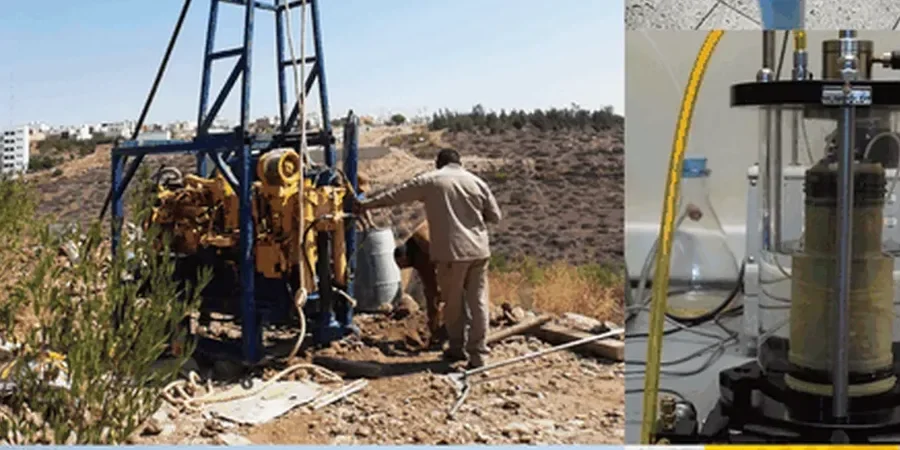
Regina sits at an elevation of 577 meters on the flat, lacustrine Regina Plain, a former glacial lakebed that left behind thick deposits of highly plastic, expansive clay. This isn't forgiving ground—annual moisture cycles cause vertical movements of up to 50 mm, enough to shear foundations and crack pavements. A soil mechanics study in Regina has to account for this from day one. When a developer breaks ground in neighbourhoods like Harbour Landing or The Towns, the first question isn't about cost; it's whether the ground will hold. Our team addresses that by quantifying undrained shear strength, consolidation parameters, and swell potential under the current NBCC framework. We don't guess—we run triaxial tests and oedometer consolidation to give you numbers you can take to your structural engineer. For sites near Wascana Creek where the water table sits barely two metres down, we often pair the investigation with a CPT test to map the soft zones before the auger even touches the clay.
Regina's clay expands and contracts with the seasons—ignore the swell pressure in your soil mechanics study and you'll be chasing cracks for a decade.
Process overview
The Quaternary geology beneath Regina is dominated by the Battleford Formation—a stiff, overconsolidated glacial till overlaid by up to 10 metres of glaciolacustrine clay. In a soil mechanics study, that upper clay layer drives the design. We classify it precisely using Atterberg limits and grain-size distribution, then measure its compressibility in a consolidometer. The numbers tell the story: liquidity indices often hover near 0.8, and preconsolidation pressures can exceed 300 kPa, which means the clay remembers the weight of two kilometres of ice. That memory is useful—it gives us a margin before virgin compression kicks in—but it's fragile. Over-excavate and the rebound can swell for months. Our lab runs ASTM D4546 swell tests on undisturbed Shelby tube samples to nail down the heave potential, and we cross-check field density with a nuclear gauge. The result is a set of design parameters—undrained cohesion, effective friction angle, constrained modulus—calibrated to the exact block you're building on.
Local geotechnical context
A three-storey condo on Dewdney Avenue started showing hairline cracks six months after occupancy. The culprit wasn't the structure—it was the backfill. The original soil mechanics study had characterized the native clay correctly, but the contractor used a silty borrow that wicked moisture from the perimeter drain. Differential heave lifted the northeast corner by 18 mm. In Regina, this scenario repeats more often than anyone admits. The risk compounds when owners skip the pre-construction swell test, assuming the clay is “just stiff.” But stiffness isn't stability—a Su of 120 kPa can drop to 40 kPa if the moisture content climbs 5%. We've seen retaining walls tilt, slab-on-grades cup, and sewer laterals shear at the property line. A proper soil mechanics study here must include a moisture-suction relationship and a clear specification for the moisture-conditioned fill. Without it, the warranty period becomes a countdown.
Common questions
How much does a soil mechanics study cost for a single-family lot in Regina?
For a typical residential lot in Regina, expect to budget between CA$4,610 and CA$6,470. The final figure depends on access, depth of investigation, and the number of lab tests required—if you're near Wascana Creek and we need to characterize soft organic silt, that pushes toward the upper end.
How deep do you drill for a soil mechanics study in Regina?
We typically extend borings to a depth of 7 to 10 metres for residential and low-rise commercial structures. This ensures we penetrate through the entire Battleford clay and into the underlying glacial till, capturing the bearing stratum and any perched water.
What makes Regina's soil different from other prairie cities?
The Regina Plain deposits are lacustrine—laid down in glacial Lake Regina—which makes them finer, more plastic, and more expansive than the coarser tills you find in Saskatoon. The active zone here reaches 3 metres, so our soil mechanics studies always include swell-consolidation testing that wouldn't be routine elsewhere.