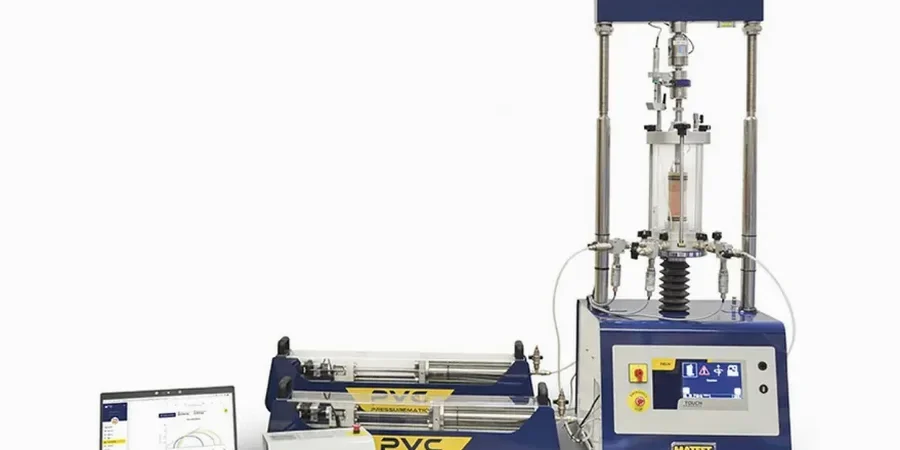
A foundation designed for the dry, compacted till in Regina's northwest industrial sector will behave very differently from one set into the high-plasticity lacustrine clays underlying the older neighborhoods south of Wascana Creek. The difference comes down to shear strength and how the soil skeleton carries load when saturated—parameters you can't extract from a simple pocket penetrometer test. Our laboratory runs consolidated-undrained (CU) and consolidated-drained (CD) triaxial tests on undisturbed Shelby tube samples taken from your borehole locations, giving you the effective friction angle and cohesion intercept the geotechnical engineer needs to size footings and evaluate bearing capacity. For deep clay profiles where serviceability governs, we often pair the triaxial program with a field CPT test to correlate tip resistance with undrained shear strength across the entire stratigraphic column, reducing the number of costly lab specimens without sacrificing design confidence. The Wascana Plain deposits are notorious for their drained-creep sensitivity under sustained load—a behavior that only a well-executed triaxial program can quantify before construction begins.
The effective friction angle of a saturated Regina clay isn't a textbook value—it's a function of depositional history, preconsolidation pressure, and drainage path length measured specimen by specimen.
Local geotechnical context
Regina sits at an elevation of 577 m on the flat Regina Plain, but don't let the gentle topography fool you—the soil column beneath the city is anything but uniform. The upper 3 to 6 meters often consist of a stiff, desiccated clay crust underlain by softer, normally consolidated to lightly overconsolidated clays that extend tens of meters down to the Bearpaw Formation bedrock. In 2018, a commercial building on the city's east side experienced differential settlement exceeding 100 mm because the triaxial data used in design came from a single depth and didn't capture the strength drop in the transition zone between the weathered crust and the intact clay below. That failure was a stark reminder that selecting confining pressures representative of your actual footing influence zone is the entire point of the test. For excavations near Dewdney Avenue or beneath the new ring road overpasses, the triaxial-derived friction angle governs the temporary cut slope design, and the consequences of getting it wrong can involve collapse during a heavy summer rain when rapid infiltration erases the matric suction that normally props up vertical cuts in these soils.
Common questions
What's the cost range for a triaxial test program in Regina?
For a standard three-specimen CU triaxial set on undisturbed Regina clay samples, the program cost typically falls between CA$2,730 and CA$3,780, depending on the number of confining stress points, the need for drained (CD) stages, and whether multi-stage testing is applied to conserve samples.
How long does a triaxial test take from sample delivery to final report?
A CU triaxial set with three confining pressures generally requires 7 to 10 working days. If drained (CD) testing is specified, the shearing phase alone can add 2 to 3 weeks per specimen due to the slow strain rate required to maintain drained conditions throughout failure.
Why can't we just use the unconfined compression test for Regina clays?
Unconfined compression (UC) tests work reasonably well for saturated, intact clays at shallow depth, but they deliver zero information about effective stress parameters, drainage behavior, or how the soil will respond once the footing load increases pore pressure. For any project where long-term settlement or slope stability matters, the triaxial test is essential.
What sample quality is required for a valid triaxial test on these soils?
We require undisturbed Shelby tube samples with a minimum diameter of 76 mm (3 in) for fissured Regina clays and 50 mm (2 in) for massive clays. The tube ends must be wax-sealed in the field immediately after recovery, and the sample must arrive at our lab no more than 48 hours post-extraction. Samples showing visible desiccation cracks or drilling disturbance are rejected before the trimming stage.