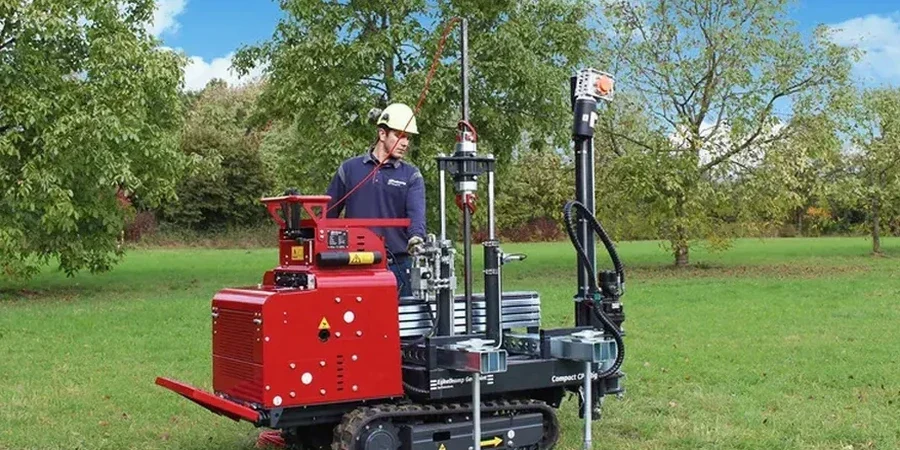
A foundation design for a warehouse in Ross Industrial Park faces completely different soil resistance than a multi-family build near Wascana Centre. The former sits on stiff glacial till while the latter contends with deep, compressible lacustrine clay deposited by glacial Lake Regina. A standard SPT drilling program gives you samples every 1.5 meters, but the cone penetration test delivers a continuous profile of tip resistance and sleeve friction — exactly what you need to spot thin silt lenses or soft pockets that discrete sampling can miss. Our CPT rig operates throughout Regina, from Harbour Landing to the refinery corridor, providing real-time data for bearing capacity and settlement analysis. The test pushes a 60-degree conical tip into the ground at 2 cm/s while measuring up to three parameters simultaneously, and we log pore pressure dissipation to estimate groundwater conditions without installing a separate well.
A single CPT sounding in Regina’s lacustrine clay can replace three boreholes for settlement profiling — continuous data changes the conversation with the geotechnical reviewer.
Common questions
What does a CPT test cost in Regina?
For a standard CPT sounding on the Regina plain, budget between CA$260 and CA$290 per meter. This includes mobilization within the city limits, the operator, calibrated cone, and a digital log with soil behavior type classification. Deeper profiles in dense till or sites requiring pre-drilling may carry a surcharge. We always deliver a fixed-price quote after reviewing your site location and target depth.
How does CPT compare to standard drilling in Regina's clay?
CPT is faster and produces a continuous resistance trace with no sample disturbance, which is critical in sensitive lacustrine clay. Drilling with SPT gives you a physical sample and a blow count every 1.5 m. In Regina, we typically use CPT for site-wide stratigraphy and settlement profiling, then selectively drill and sample at depths the CPT identifies as critical. The two methods are complementary, not competing.
Can CPT determine soil type without taking a sample?
Yes, but with an important caveat. The friction ratio and pore pressure response allow classification using the Robertson chart, which is reliable for Regina's glacial and post-glacial deposits. However, for final foundation design, we recommend a thin-walled Shelby tube sample at one or two key depths to confirm classification and run laboratory tests. The CPT tells you where to sample with precision.