Our field teams work with a self-contained CPT rig mounted on a tracked carrier, the right tool for moving across the soft, slick Regina clay after a prairie rain. The 20-tonne hydraulic push system lets us advance the cone through the full depth of the glaciolacustrine sequence—often 12 to 20 metres—without the sample disturbance you get from a drill stem. Once we have a continuous profile of tip resistance and sleeve friction, the shallow foundation design moves from assumption to calculation. We pair those readings with lab consolidation tests to model settlement under the design load, because in a city where the Lake Agassiz clays can compress several centimetres under a modest strip footing, knowing the exact preconsolidation pressure is everything. For projects near Wascana Creek or the ring road corridor, where fill thickness varies unpredictably, we often cross-check the CPT data with a test pit investigation to visually log the contact between native clay and overlying granular pad before finalizing the bearing depth.
Regina's Lake Agassiz clays can lose more than 50 percent of their undisturbed strength when remoulded—a sensitivity that makes undisturbed sampling and conservative bearing pressure selection non-negotiable.
Process overview
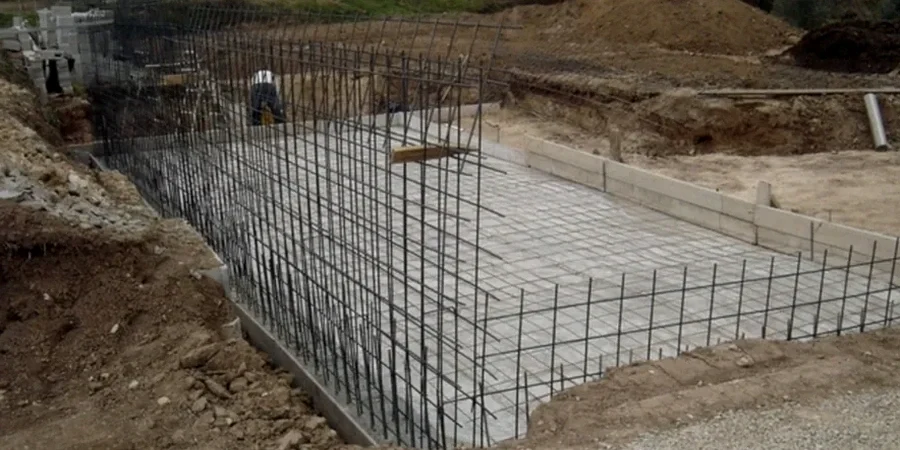
A footing designed for the stiff, oxidized crust in the Cathedral neighbourhood works on a completely different set of assumptions than one placed in the softer, wetter clays out toward Harbour Landing. The south end of Regina sits on a thicker sequence of plastic, high-plasticity lacustrine clay—liquid limits routinely above 60 percent—so the allowable bearing pressure drops fast if you ignore the sensitivity. Our design process always starts with a desktop review of the surficial geology, then moves to site-specific sampling: thin-walled Shelby tubes for oedometer tests, bulk samples for Atterberg limits, and direct shear on the crust material. When the client is considering a mat foundation to span variable subgrade, we run the numbers through a
plate load test program to get a direct modulus of subgrade reaction, which feeds the finite element model more reliably than correlations from SPT blow counts. In the industrial subdivisions north of Victoria Avenue, where the till is shallower, we sometimes supplement the investigation with
standard penetration testing to characterize the transition from clay to dense basal till—a contact that governs both bearing capacity and the depth of the frost-protected footing.
Local geotechnical context
Regina's climate punishes shallow foundations with a freeze-thaw cycle that runs from late October into April. Wet, frost-susceptible clay heaves, then softens during the spring melt, and that annual movement can rack a lightly loaded footing in just a few seasons. The 2015 National Building Code of Canada assigns Regina to Region 6, so our designs default to a minimum 1.8-metre frost protection depth unless a heated basement or rigid insulation blanket changes the thermal regime. Moisture is the other silent risk: the flat Regina Lake Plain drains poorly, and a wetter-than-average year can raise the groundwater table to within a metre of grade in low-lying subdivisions, cutting the effective bearing capacity. We specify a capillary break of clean granular fill beneath every slab-on-grade and recommend perimeter drainage that slopes to a positive outfall—standing water against a footing in this clay is a long-term settlement trigger, not a short-term nuisance.
Reference standards
NBCC 2015 (National Building Code of Canada, Division B, Part 4), CSA A23.3:14 (Design of Concrete Structures – Foundations), ASTM D1196 (Plate Load Test – bearing capacity of soil for shallow foundations), ASTM D2435 (One-Dimensional Consolidation Properties of Soils), Canadian Foundation Engineering Manual (CFEM) 4th Edition
Common questions
What will shallow foundation design cost for a typical residential or light commercial project in Regina?
For a single-family home or a small commercial building in Regina, the complete design package—including the CPT sounding, laboratory consolidation and strength testing, bearing capacity calculations, and the stamped engineering report—typically runs between CA$2,390 and CA$4,490. The final number depends on the number of test locations, the depth of the clay investigation, and how much laboratory testing is needed to define the preconsolidation pressure profile. We deliver a fixed-price proposal after reviewing the site address and the structural loads.
How deep do you need to investigate the soil for a shallow foundation in Regina's clay?
We usually extend the investigation to a depth where the net stress increase from the footing is less than 10 percent of the in-situ effective stress—for a typical 1.5-metre-wide strip footing on Regina clay, that means a borehole or CPT sounding to at least 12 metres. If a mat foundation is being considered, or if the structural loads are unusually heavy, we go deeper to capture the full thickness of the lacustrine clay and confirm the depth to the glacial till, which often sits between 15 and 25 metres below grade.
Do we really need a site-specific investigation, or can we use the bearing pressures from the city's typical soil report?
The City of Regina's building department will not issue a permit for a permanent structure without a site-specific geotechnical report. The glaciolacustrine clays change significantly over short distances—the stiff crust can be 2 metres thick on one lot and less than a metre on the next—and relying on a neighbouring property's report is a gamble with both bearing capacity and differential settlement. Our investigation is tailored to your specific foundation footprint and load configuration.
How do you handle the swelling and shrinkage potential of the clay beneath a slab-on-grade?
We run Atterberg limits and, when the plasticity index is above 25 percent, we also measure the free swell index and suction-water content relationship. The design response is a moisture-control strategy: we specify a minimum 200 mm of clean, well-graded granular fill as a capillary break, recommend extended downspout leaders that discharge at least 2 metres from the foundation, and grade the perimeter to a positive slope. For highly active zones, we may also call for a rigid insulation layer beneath the slab to dampen seasonal temperature swings in the subgrade.