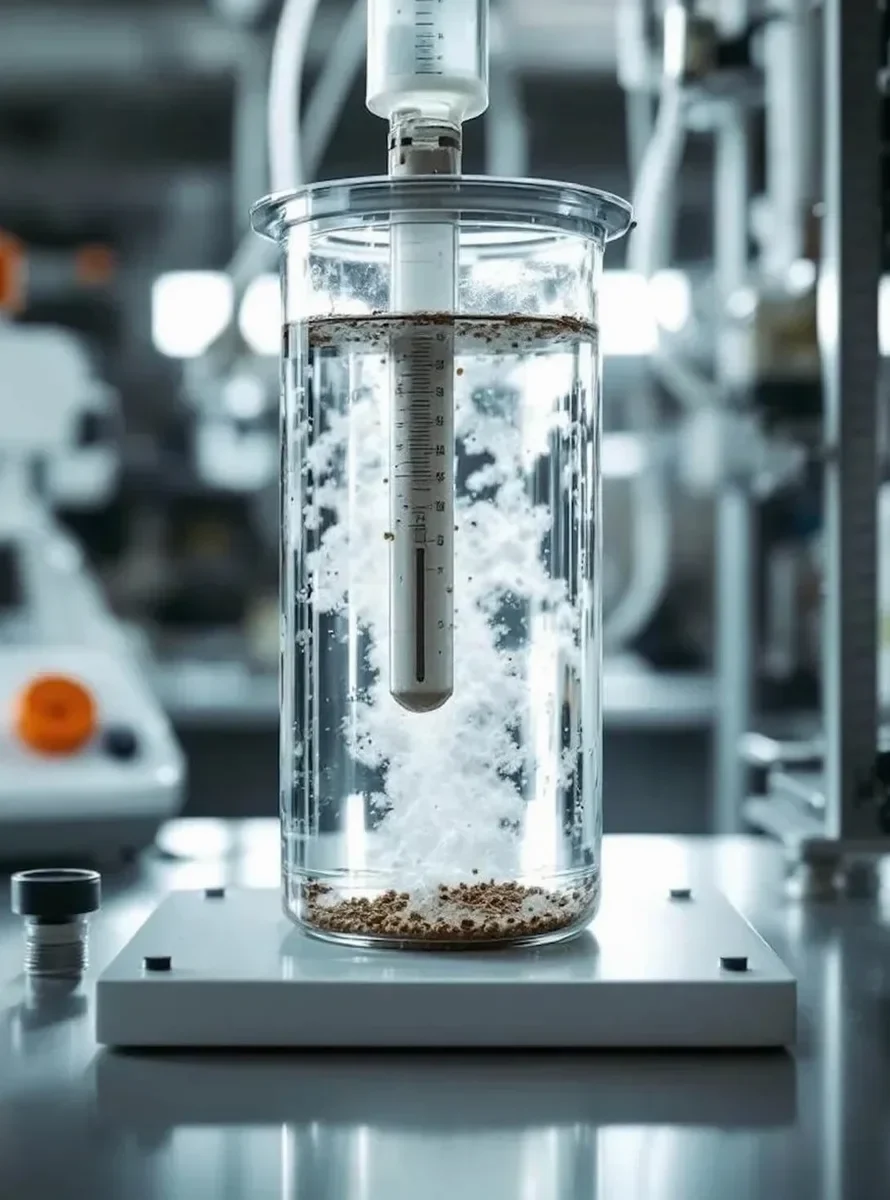
On a recent project near Wascana Lake, the contractor was frustrated because the fill material wouldn't compact properly despite multiple passes. The issue wasn't the compactor—it was the gradation. We ran a full grain size analysis combining the mechanical sieve stack with a hydrometer sedimentation test, and the curve showed a gap-graded material that simply wouldn't lock up. That kind of problem is more common than people think around Regina. The glacial lake plain that underlies the city—particularly the heavy lacustrine silts and clays north of Victoria Avenue—demands precise particle size distribution data before you commit to a borrow source or approve structural fill. Whether you are dealing with a deep excavation in the downtown core or a residential footing on the east side, knowing the exact sand-silt-clay split from the hydrometer test, plus the coarse fraction breakdown from the sieves, lets you predict drainage behavior, frost susceptibility, and long-term settlement with confidence. We process samples through our Atterberg limits testing alongside the grain size curve so the full plasticity framework lines up with the gradation data and you get a defensible soil classification under the Unified Soil Classification System.
You can design a foundation on assumptions, or you can design it on a gradation curve that leaves nothing to chance. In Regina silts, the hydrometer data makes that choice for you.
Process overview
A couple of winters ago, a pile-supported building going up near the Ring Road ran into water seepage that nobody had modeled correctly. The geotechnical report had classified the material based on a quick field estimate, but the lab grain size analysis told a different story—over 40 percent silt content in a layer that was supposed to behave like free-draining sand.
That single lab curve changed the dewatering plan and saved weeks of delay. In Regina, you cannot afford to guess particle size distribution when the native soils range from well-graded glacial till to highly compressible lacustrine clays. Our grain size analysis covers the full spectrum: coarse sieves for gravel and sand fractions, fine sieves down to the 75-micron cutoff, and a hydrometer test that captures silt and clay colloids in suspension using ASTM D422 methodology. For projects where the fines control permeability or frost heave potential, we often recommend pairing grain size with
in-situ permeability testing to correlate the lab curve with actual field hydraulic conductivity. The data also feeds directly into pavement design when you are working on a roadway subgrade, so we frequently run parallel
CBR road subgrade evaluations on the same sample set to give the civil designer a complete package without multiple mobilizations.
Local geotechnical context
Much of Regina sits on up to 20 meters of glaciolacustrine silt and clay deposited by glacial Lake Regina. This material is notorious for its frost susceptibility and low permeability. Without a complete grain size analysis that includes the hydrometer test, you cannot reliably determine the frost-susceptibility classification under Canadian foundation engineering practice, nor can you estimate the drainage characteristics that govern basement waterproofing and weeping tile performance.
If you skip the sedimentation analysis and only run a sieve test, you miss the fine fraction entirely—and that is precisely the fraction that causes most of the problems: differential heave, retaining wall backfill failure, and subgrade softening during spring thaw. In a city where winter temperatures routinely drop below minus 30 degrees Celsius and the frost penetration depth exceeds 2 meters, the grain size curve is not just a lab report—it is the document that tells you whether your foundation insulation design will actually work. Soil with more than 10 percent finer than 0.02 mm demands special consideration under the National Building Code of Canada, and the hydrometer test is the only way to quantify that reliably.
Common questions
How much does a grain size analysis with sieve and hydrometer cost in Regina?
A complete combined sieve-and-hydrometer test in our Regina lab typically runs between CA$140 and CA$260 per sample, depending on whether you need the full hydrometer sedimentation curve or just the fines percentage. If you are submitting multiple samples from the same site, we can usually apply a volume discount that brings the per-sample cost toward the lower end of that range. The price includes sample preparation, the full gradation report with D-values and uniformity coefficients, and a USCS classification. Expedited turnaround for active construction projects may carry a small surcharge.
How long does the hydrometer test take compared to the sieve test?
The sieve portion is relatively quick—we can run a full stack from 19 mm down to the No. 200 sieve within a few hours once the sample is oven-dried and prepared. The hydrometer test takes longer because it relies on sedimentation over time: we take readings at 2 minutes, 5 minutes, 15 minutes, 30 minutes, 1 hour, 2 hours, 4 hours, and 24 hours to build the fine-particle distribution curve accurately. For that reason, a standard combined grain size analysis in Regina has a 2-to-3-business-day turnaround. Same-day or next-day results are possible for the sieve portion alone if you only need the coarse fraction data.
Why do I need the hydrometer part for a Regina foundation? Can't I just use a sieve test?
In Regina's glaciolacustrine soils, the silt and clay fraction often makes up more than 50 percent of the material, and everything that passes the No. 200 sieve (0.075 mm) is invisible to a sieve test. The hydrometer analysis is the only lab method that separates silt-sized particles from clay-sized colloids, and that distinction matters enormously for frost heave classification, drainage design, and settlement prediction. The National Building Code of Canada ties foundation insulation requirements directly to the fines content of the subgrade. If you submit a sieve-only report for a silty site in Harbour Landing or the Greens, you are effectively designing without knowing the most critical soil parameter.