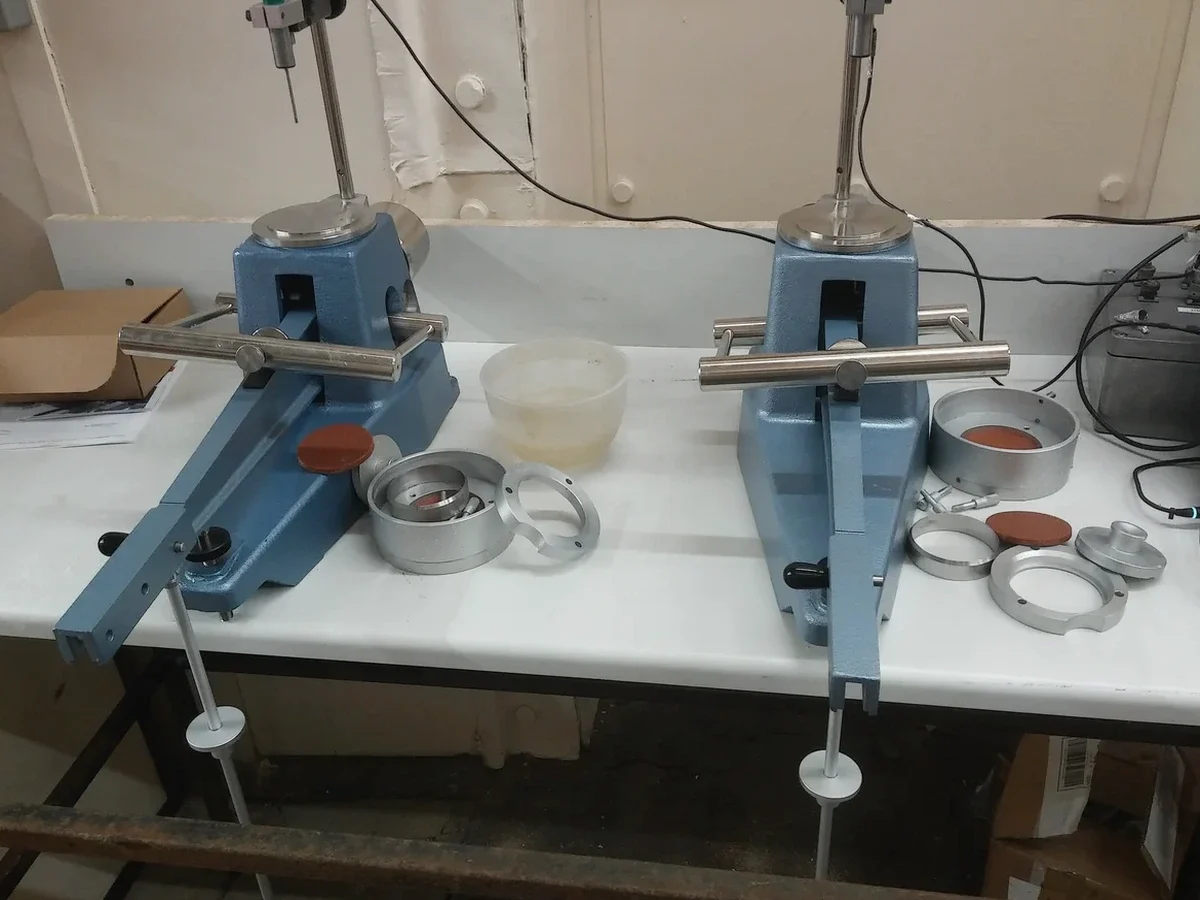
Regina’s expansion through the early 1900s followed the railway, but the real story lies beneath the streets. The city sits on the flat, lacustrine plain of glacial Lake Regina—a thick sequence of high-plasticity clays and silts that can test the patience of any foundation engineer. When these soils take on water, they swell; when they dry, they shrink. That volume change is what drives the need for careful index testing. Over the years, the team has seen more than a few projects stall because the clay’s behaviour wasn’t fully characterized. The Atterberg limits test, run under ASTM D4318, gives us a clear window into that behaviour. It tells us exactly where the soil transitions from brittle solid to plastic mess, and finally to liquid. For a city built on this kind of glacial deposit, running grain-size analysis alongside Atterberg limits often completes the picture, letting us classify the material and predict how it’ll perform under seasonal moisture swings.
On the Regina lacustrine plain, a ten-point jump in plasticity index can be the difference between a stable footing and a seasonally heaving slab.
Process overview
With a population hovering around 230,000 and a frost depth that can reach 2.3 metres, Regina’s geotechnical challenges are shaped by extremes. What we see most in this region is the battle between high-plasticity glacial clays and the semiarid climate—hot summers, frigid winters, and less than 390 mm of precipitation a year. The Plasticity Index (PI) we calculate from Atterberg limits becomes a key number here. If the PI runs above 25, which it often does in north-central Regina, you’re looking at a soil with high swell potential—something you absolutely need to account for in footing and slab-on-grade design. The test itself is straightforward: we take a sample passing the No. 40 sieve, mix it with distilled water, and work it until the thread crumbles at 3.2 mm diameter for the plastic limit. For the liquid limit, we use the Casagrande cup method, counting the blows needed to close a groove. It sounds old-school, and it is—but it remains one of the most reliable indicators of soil consistency anywhere on the prairies.
Local geotechnical context
The National Building Code of Canada (NBCC 2020) classifies much of Regina’s subsurface as ‘highly expansive’ or ‘sensitive’ clay, and for good reason. Ignoring the Atterberg limits on a commercial build here isn’t a minor oversight—it’s a direct path to differential heaving, cracked slabs, and utility line breaks within the first few freeze-thaw cycles. The clay deposits around Wascana Creek are notorious for their high liquid limits and correspondingly high shrinkage potential. When the natural water content drifts too close to the liquid limit, the soil loses shear strength rapidly under load. That’s why our reports always flag the Liquidity Index alongside the PI. If LI approaches or exceeds 1.0, you’re dealing with a soil that can flow under its own weight—a condition that demands a serious rethink of excavation support and foundation depth. This is especially critical in Regina’s older neighbourhoods where infill development places new loads next to weathered, moisture-sensitive clays.
Reference standards
ASTM D4318-17e1 – Standard Test Methods for Liquid Limit, Plastic Limit, and Plasticity Index of Soils, NBCC 2020 – Section 4.2.4, expansive soil considerations for foundations, CSA A23.3 – Design of concrete structures, accounting for soil volume change, ASTM D2487-17 – Unified Soil Classification System (USCS), using Atterberg results
Common questions
What does the plasticity index tell me about a soil in Regina?
The plasticity index is the numerical difference between the liquid limit and the plastic limit. Soils with a PI between 20 and 45—common in Regina’s glacial lake deposits—tend to have high swell-shrink potential. A higher PI generally means more volume change with seasonal moisture variation, which directly affects footing depth and slab reinforcement requirements under NBCC 2020.
How much does Atterberg limits testing cost for a typical lot in Regina?
For a standard set of Atterberg limits on a single sample, you’re typically looking at CA$100 to CA$150. The final amount depends on how many samples you need and whether we’re also running a full hydrometer or one-dimensional swell test alongside it. Most residential projects in Regina submit two to three samples from different depths.
Do I need Atterberg limits if I’m already doing a grain size analysis?
Almost always, yes—especially in Regina. The grain size distribution tells you the proportions of sand, silt, and clay, but it doesn’t describe how the clay fraction behaves with water. Atterberg limits fill that gap by measuring the soil’s consistency states. Together, they give you a complete USCS classification and a reliable way to assess shrink-swell risk.
How long does it take to get results on a set of Atterberg limits?
From the moment the sample arrives in the lab, standard turnaround is three to four business days. If the project is on a tight timeline—say, a footing inspection that hit unexpected clay—we can often push results through in 24 to 48 hours. The limiting step is the overnight oven-drying required to calculate accurate moisture contents.