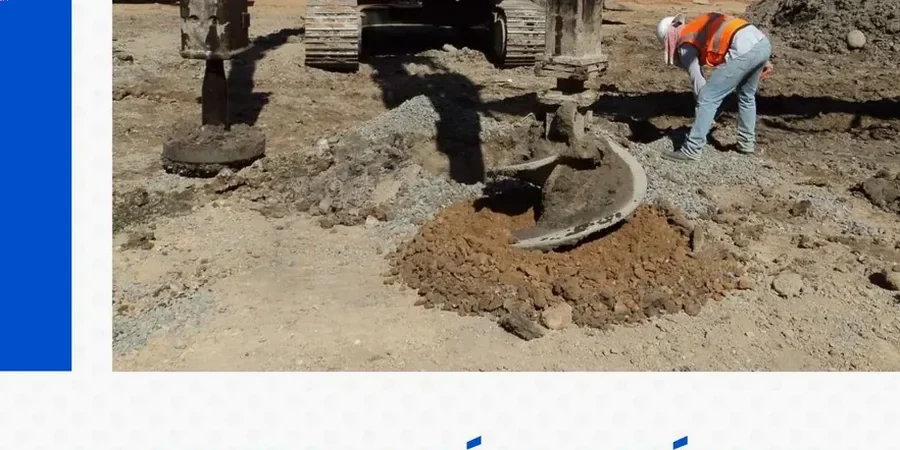
A common mistake on Regina construction sites is treating stone columns as simple gravel piles and skipping the site-specific design phase. This shortcut backfires fast on the glaciolacustrine clays that underlie much of the city. Without a proper bearing analysis and settlement check, columns either punch through the soft layer or fail to transfer load to the competent till below. The team behind our stone column work starts with the stratigraphy. Regina sits on thick deposits of Lake Regina clay—locally up to 15 metres deep—overlying a stiffer till unit. CPT testing in these conditions gives a continuous strength profile, showing exactly where the transition occurs. When fill is present, we often combine column design with vibrocompaction to densify the upper crust before installation. That dual approach prevents drilling collapse and gives a more uniform load distribution.
A stone column in Regina clay works as a drain as much as a load-bearing element—consolidation time often controls the construction schedule.
Reference standards
NBCC 2020 — National Building Code of Canada, structural design provisions, CSA A23.3 — Design of concrete structures (caps and load transfer platforms), ASTM D1194 / D1195 — Plate load test methods for treated ground verification, CFEM — Canadian Foundation Engineering Manual, 4th ed. (ground improvement chapter)
Common questions
What does stone column design cost for a typical Regina site?
The engineering package for a standard residential or low-rise commercial site in Regina typically ranges from CA$2,000 to CA$7,000. Variables include the number of CPT soundings needed, whether a plate load test is required, and the complexity of the settlement analysis.
When are stone columns a better choice than piles in Regina?
When the soft clay layer is less than about 12 to 15 metres thick and the structural loads are moderate. Stone columns improve the ground in situ, avoiding the cost of deep pile caps, and they accelerate consolidation drainage, which shortens the wait time before slab construction.
How do you verify the columns actually work?
We specify a zone load test or individual plate load tests on selected columns, measuring settlement under design load. The results are compared against the settlement reduction factor used in the unit cell model. If field modulus is lower, we tighten the grid before production continues.
Do stone columns work in Regina winter conditions?
Installation can proceed in winter, but the granular blanket and column material must be free of ice and frozen lumps. The biggest challenge is maintaining the drainage function during spring thaw, so the design always includes a positive drainage outlet to prevent water pooling in the load transfer platform.