← Home · Slopes & Walls

Active/Passive Anchor Design for Deep Excavations and Retaining Structures in Regina

Together, we solve the challenges of tomorrow.

LEARN MORE →

Regina's expansion through the mid-20th century pushed construction southward across Wascana Creek into areas where the glacial Lake Regina sediments dominate the subsurface profile. The city sits on up to 18 meters of high-plasticity lacustrine clay overlying glacial till, a sequence that makes lateral earth support systems far more demanding than a simple cantilever wall can handle. When a developer breaks ground for a parkade near Victoria Avenue or a utility vault in the Warehouse District, the shoring solution almost always requires active/passive anchor design to manage the sustained creep pressure these clays exert over time. Our team has worked extensively with the local stratigraphy, including the stiff upper till at roughly 9 to 12 meters depth that serves as a reliable bond zone for strand anchors. We pair this understanding with the slope stability analysis methods described by Spencer and Morgenstern-Price to verify global stability, and we routinely specify deep excavations monitoring protocols when adjacent structures require settlement thresholds below 10 millimeters.

Saskatchewan's high-plasticity clays exert long-term lateral pressures that a simple Rankine analysis cannot capture—anchored systems must account for undrained stability during construction and drained creep over the structure's service life.

Methodology and scope

The contrast between two Regina neighborhoods illustrates why anchor design here cannot follow a generic catalogue approach. In the Cathedral area, where many buildings date from the 1910s and 1920s, the soil profile typically shows a desiccated crust extending 3 to 4 meters below grade before transitioning into soft, near-normally consolidated clay—ideal conditions for passive anchors with long unbonded lengths to reach competent till. Move east to the industrial lands near the Ring Road and the upper till appears much closer to the surface, sometimes within 5 meters, allowing shorter active strand anchors with higher lock-off loads. We have also encountered artesian conditions in several boreholes north of Dewdney Avenue, where groundwater from the Condie aquifer rises through fractures in the till, forcing us to adapt the watertightness of the anchor head assembly. We often combine anchor design with triaxial testing on undisturbed Shelby tube samples to confirm the drained friction angle used in the bond length calculation, and with grain-size analysis on the till matrix to estimate long-term creep potential.
Active/Passive Anchor Design for Deep Excavations and Retaining Structures in Regina
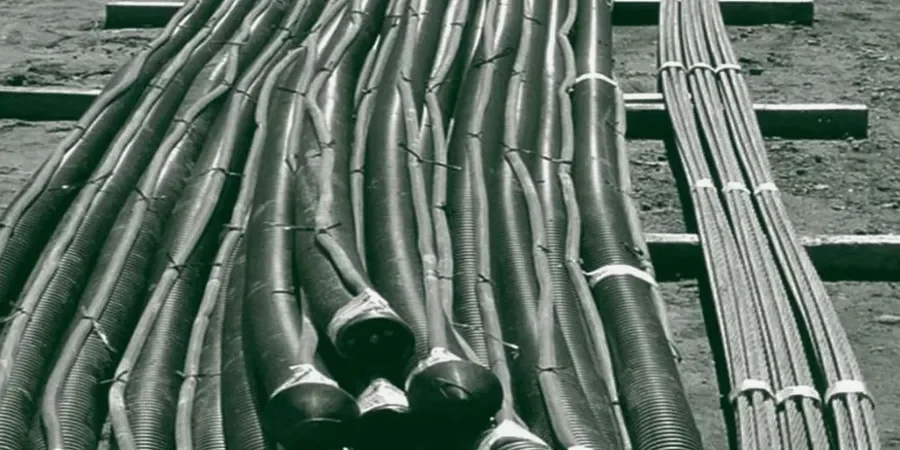
Technical reference image — Regina

Local geotechnical context

The National Building Code of Canada (NBCC 2020) classifies Regina as having moderately high seismic hazard for long-period structures, and the CSA A23.3 standard mandates anchor design to consider the amplified ground motions that soft clays produce. The biggest risk in this city is not the anchor steel itself but the progressive loss of bond in the clay zone under cyclic loading—something documented extensively in the geotechnical literature since Seed and Idriss's work on soil-structure interaction. An under-designed passive anchor system in the lacustrine clay can lose 15 to 20 percent of its lock-off load within the first year simply through stress relaxation in the grout-soil interface. We address this by specifying sacrificial anode protection for permanent anchors in soils with sulfate concentrations above 1,500 ppm, a condition we have measured in multiple soil reports from the Ross Industrial Park to the Greens on Gardiner. Our anchor designs also incorporate creep testing at 100 percent of the design load for a minimum of 72 hours when the bond zone intersects the clay-till transition—a protocol drawn from the Post-Tensioning Institute guidelines and from direct experience with performance monitoring on three multi-story excavations along Albert Street.

Need a geotechnical assessment?

Reply within 24h.

Email: info@geotechnicalengineering.vip

Typical values

ParameterTypical value
Design standardCSA A23.3 Annex D (anchors) + NBCC 2020 seismic
Typical anchor capacity200–800 kN per strand anchor in Regina till
Bond length in glacial till4–8 m depending on tendon type and grout pressure
Free length minimum4.5 m per CSA A23.3, often extended to 7–9 m in soft clay
Lock-off load (% of fpu)65–70% for active anchors, 25–35% for passive tiebacks
Proof testing load133% of design load held for 10–60 minutes
Corrosion protection classClass I (double protection) per PTI recommendations

Related services

01

Active Anchor System Design

Full design of post-tensioned strand anchors with lock-off loads between 200 and 800 kN for permanent retaining walls, bridge abutments, and deep basement shoring. Includes bond length verification using FHWA/PTI methods adapted to Regina till friction angles.

02

Passive Tieback and Soil Nail Systems

Design of grouted passive anchors and soil nails for temporary and permanent excavation support in the lacustrine clay zone. We define spacing, inclination, and grout injection pressure based on site-specific undrained shear strength profiles.

03

Anchor Load Testing and Verification

Performance, proof, and creep testing programs executed per PTI DC35.1-14. Our team supervises the jacking sequence and interprets the load-displacement curves to confirm the design bond stress assumptions before the contractor proceeds with lock-off.

Applicable standards

CSA A23.3: Design of Concrete Structures – Annex D (Anchoring to Concrete and Rock), NBCC 2020 – Division B, Part 4 (Structural Design) – Seismic provisions for Regina, PTI DC35.1-14: Recommendations for Prestressed Rock and Soil Anchors, ASTM A416/A416M: Standard Specification for Low-Relaxation Seven-Wire Steel Strand, CAN/CSA-G40.20/G40.21: General Requirements for Rolled or Welded Structural Quality Steel

Common questions

How much does an active/passive anchor design service cost for a project in Regina?

Our anchor design fees for a typical Regina excavation project range from CA$1,500 to CA$4,730 depending on the number of anchor rows, the complexity of the soil profile, and whether proof testing supervision is included. A single-family lot retaining wall with 2–3 anchors sits at the lower end; a multi-level parkade excavation with four rows of strand anchors and a full testing program falls at the upper end of that range.

What is the difference between active and passive anchors in Regina's clay soils?

Active anchors are post-tensioned to a lock-off load (typically 65–70% of the tendon's ultimate strength) immediately after the grout reaches sufficient strength, actively compressing the retained soil mass and reducing lateral movement. Passive anchors are not prestressed; they develop resistance only when the wall moves enough to engage the tendon, making them suitable for temporary cuts in the stiff upper till where some deformation is acceptable. In Regina's soft lacustrine clay, we almost always specify active anchors for permanent structures because the creep rate under sustained load is lower than the deformation required to mobilize a passive system.

How do you determine the bond length in Regina's glacial till?

We calculate bond length using the effective stress approach, multiplying the average overburden pressure at the bond zone by a friction factor derived from drained triaxial testing on undisturbed till samples. In the till underlying Regina, we typically use a grout-to-ground bond stress of 80–120 kPa for low-pressure gravity-grouted anchors, increasing to 200–350 kPa when post-grouting techniques are employed. Every design is verified by on-site proof testing; we require a minimum of three sacrificial test anchors when the bond zone is within 2 meters of the clay-till interface.

Are there any special corrosion protection requirements for anchors in Saskatchewan soils?

Yes. The sulfate-rich nature of the glacial lake sediments in the Regina area—often exceeding 1,500 ppm in the upper 5 meters—requires Class I double-corrosion protection per PTI recommendations for all permanent anchors. This means a corrugated plastic sheathing over the full free length, epoxy coating on the strand in the bond zone, and a watertight encapsulation at the anchor head. We also specify electrical isolation testing between the strand and the surrounding steel reinforcement before lock-off to verify the integrity of the protection system.
Location and service area

We serve projects in Regina and surrounding areas.

View larger map