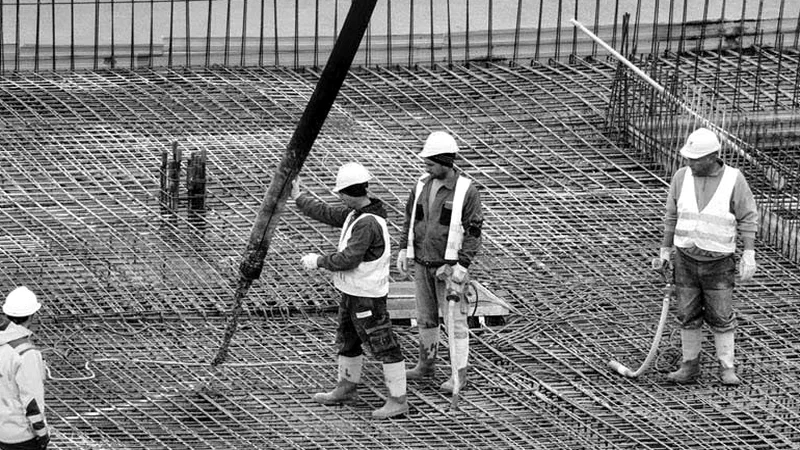
The first thing our field crews set up on a Regina site is the drilling rig—usually a truck-mounted CME-75 or a Geoprobe unit that can punch through the glacial lake clay and into the till beneath. Regina sits on a deep basin of lacustrine clay that swells when it rains and shrinks when it dries, a cycle that wrecks conventional footings over time. A raft or mat foundation is the most practical way to spread the structural load wide enough that differential movement becomes manageable rather than catastrophic. We sample the clay at intervals down to refusal, run index tests in our lab, and feed that data into a finite element model calibrated for the local stratigraphy. The goal is a slab that floats on the reactive zone without cracking the superstructure.
A well-designed raft in Regina converts differential heave into uniform tilt—predictable, manageable, and far cheaper than repairing a cracked footing after two freeze-thaw cycles.
Local geotechnical context
The most common mistake we see contractors make around Regina is ordering a raft foundation based on a desktop study or a single borehole at the property corner. The lacustrine clay here is not homogeneous—we have encountered silt lenses, pockets of organic material from old sloughs, and sandier layers where the Wascana Creek floodplain crosses the city. If the geotechnical model misses a soft pocket under one quadrant of the raft, the slab will dish, door frames will bind, and partition walls will crack within the first two years. Another frequent issue is ignoring the frost depth: Regina requires foundation bearing at least 1.8 m below finished grade, but a raft still needs an insulated skirt or thickened edge to prevent frost jacking at the perimeter. We combine in-situ permeability testing with volume-change potential indices to define the sub-slab drainage and vapour barrier requirements, because a wet subgrade under a heated building can pump moisture into the slab and cause efflorescence or adhesive failures.
Common questions
Why is a raft foundation often recommended over strip footings in Regina?
Regina is underlain by glaciolacustrine clay that undergoes significant volume change with moisture variation. Strip footings concentrate loads in narrow lines, which amplifies differential movement when one part of the footing sits on drier clay than another. A raft foundation bridges across soft spots, spreads the building load over a much larger footprint, and adds stiffness that resists distortion. In our track record, the cost premium for a raft is usually recovered within the first decade by avoiding structural repairs.
What is the typical cost range for a raft foundation design in Regina?
For a single-family residential or light commercial raft foundation in Regina, the geotechnical investigation and structural design package typically falls between CA$1,460 and CA$5,360, depending on the number of boreholes, laboratory testing scope, and complexity of the superstructure. Larger industrial mats with multiple column lines and heavy equipment loads require a more detailed scope and are quoted on a project basis.
How do you account for frost heave under a raft foundation?
The NBCC prescribes a minimum footing depth of 1.8 m in Regina to get below the frost line. For a raft, we achieve this by casting a thickened perimeter beam or by installing rigid insulation extending outward horizontally from the slab edge. This keeps the subgrade temperature above freezing and prevents ice lens formation. We also specify a granular capillary break and a high-performance vapour barrier to decouple the slab from soil moisture fluctuations.