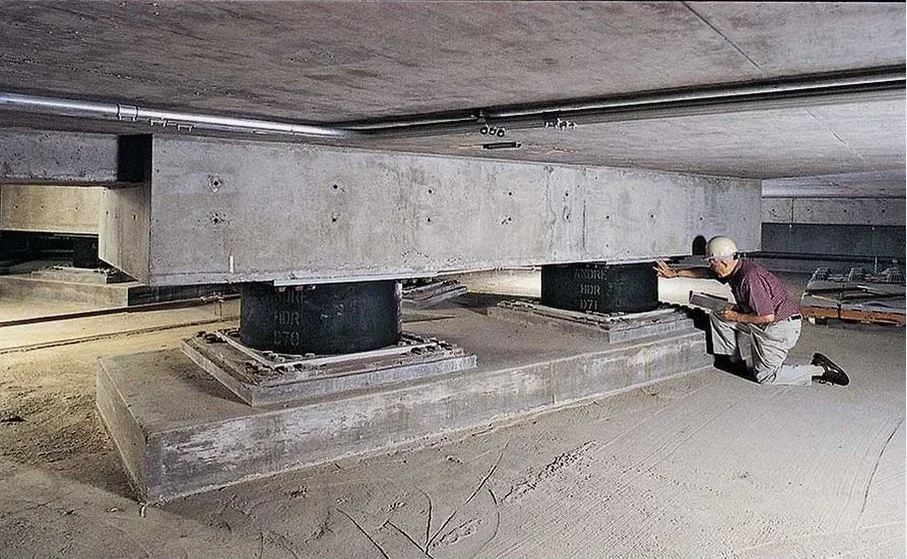
Regina's steady expansion from a Pile of Bones encampment to a modern prairie capital has always contended with what lies beneath: deep lacustrine clays deposited by glacial Lake Regina. This history shapes every structure we design today. Base isolation seismic design demands more than standard bearing capacity checks—it requires precise dynamic characterization of the soil column to calibrate isolator properties. In our geotechnical laboratory, we approach each project by first understanding the stratigraphy, then selecting testing protocols that reflect how the ground actually moves during a seismic event. While Saskatchewan's seismicity is moderate, the high plasticity of Regina clay amplifies long-period motions, making a site-specific response spectrum essential. We often pair advanced resonant column testing with routine field investigations to build a ground model that feeds directly into isolation system design, ensuring the soil-structure interaction is captured before the first isolator is specified. For deeper profiling across the city's variable till and clay interfaces, we coordinate with our field crews performing seismic refraction surveys to map shear wave velocity contrasts that dictate isolation frequency ranges.
In our experience with Regina's glacial clays, the difference between a successful base isolation design and an underpredicted displacement often lies in the damping ratio measured at strains below 0.001%.
Local geotechnical context
The contrast between Regina's downtown core and the newer subdivisions in the southeast—like Greens on Gardiner—illustrates a fundamental risk in base isolation design. Downtown, the near-surface soils often include dense, overconsolidated glacial till that provides a stiff bearing stratum and relatively high shear wave velocities. Move four kilometers southeast, and the till is overlain by ten to fifteen meters of soft, normally consolidated clay with a plasticity index exceeding 40%. An isolation system tuned for a stiff Site Class C profile downtown will perform very differently on a Site Class E profile in the southeast, where amplified long-period ground motion can push isolator displacement beyond design limits. We have seen projects where ignoring this transition led to costly mid-design rework. Our approach involves drilling and sampling at each isolator location when stratigraphy is uncertain, running resonant column or cyclic triaxial tests on the most critical clay specimens, and providing the structural engineer with upper-bound, lower-bound, and best-estimate soil springs and damping values so the isolation system can be checked against the full range of subsurface conditions.
Common questions
How much does a laboratory testing program for base isolation design typically cost in Regina?
A complete laboratory testing program for base isolation design in Regina—including resonant column or cyclic triaxial on three to five specimens, bender element shear wave velocity measurements, index testing, and consolidation—typically ranges from CA$6,400 to CA$10,700. The final cost depends on the number of isolator locations, the depth of the compressible clay profile, and whether field geophysical correlation is required. We deliver a detailed proposal after reviewing the borehole logs and the proposed isolator layout.
What makes Regina's soil conditions different for base isolation compared to other Canadian cities?
Regina sits on glaciolacustrine deposits from glacial Lake Regina, which left behind thick sequences of high-plasticity, normally consolidated clay with a well-documented capacity to amplify long-period seismic motion. Unlike cities founded on rock or dense till, Regina's clay can produce a site period exceeding 1.0 second in deeper deposits, which falls within the typical isolation range and can create resonance if not properly characterized. The sensitivity of the clay also means that sample disturbance during drilling must be minimized—we rely heavily on Shelby tube sampling and careful specimen preparation to preserve the in-situ structure for dynamic testing.
Which laboratory tests are most critical for a base isolation project in Regina?
For base isolation design, the most critical tests are those that define stiffness and damping at small to moderate strains. We prioritize resonant column testing to capture the low-strain shear modulus and damping baseline, supplemented by cyclic triaxial tests to extend the modulus reduction and damping ratio curves to higher strains. Bender element measurements on the same specimens deliver a direct Vs value for correlation with field geophysics. Consolidation testing is equally important in Regina's clays to predict isolator settlement over the structure's service life. A full Atterberg limits and grain size suite rounds out the program by confirming stratigraphic consistency across the site.