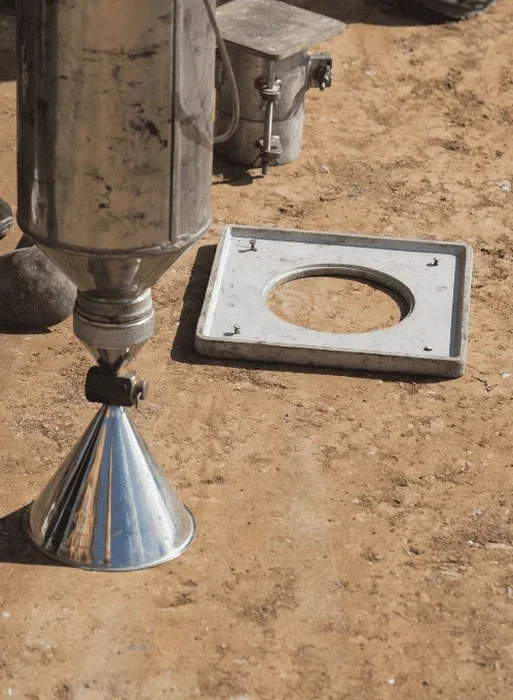
We still see crews in Regina running a smooth-drum roller over a utility trench backfill and calling it compacted. A week later, the asphalt settles two inches. A test pit would expose the loose lifts underneath, but by then the repair budget is already blown. The sand cone method catches this early. It directly measures in-place density, comparing it to the lab Proctor value. No indirect gauge calibration, no guessing. On Regina’s high-plasticity glacial lake clays, a density reading taken at the wrong moisture content is worthless; we pair the sand cone with a quick Atterberg limits check to confirm the material is in the right compaction window. For deep utility work near Wascana Creek, we often combine density testing with in-situ permeability assessment to verify the clay liner’s integrity before backfill placement.
A sand cone test doesn’t estimate density — it measures it. In Regina’s moisture-sensitive clays, that distinction saves foundations from differential settlement.
Process overview
Regina sits at roughly 577 meters elevation on a flat lacustrine plain, where the near-surface soils are predominantly stiff, overconsolidated glacial till and glacio-lacustrine silty clays. These clays are moisture-sensitive — a 2% swing above optimum can turn a solid lift into a pumping failure. The sand cone method, following ASTM D1556, remains the most transparent way to document compaction because it leaves a physical sample. There’s no nuclear gauge source to license, no dielectric constant assumptions. Our technicians carry calibrated density sand and a field scale; the hole volume is measured directly, and the wet density is computed on-site. For projects under the National Building Code of Canada and CSA A23.3, we report the percent compaction relative to the standard Proctor maximum dry density. A typical granular base in east Regina’s industrial subdivisions needs 98% modified Proctor; the clay subgrade beneath it often targets 95% standard Proctor. If the subgrade fails, we can design a vibrocompaction treatment plan to improve bearing capacity before placing the structural fill.
Local geotechnical context
Regina’s subgrade is dominated by the Regina Clay formation — a preconsolidated, highly plastic lacustrine clay that swells when wet and shrinks during dry summers. The 2021 drought caused foundation movement in several northwest neighborhoods precisely because fill around footings wasn’t compacted to density specs. When backfill lifts are placed too thick or at the wrong moisture, the sand cone result fails, and the contractor reworks the lift. That’s the cheap fix. The expensive fix happens when density testing is skipped: buried utilities shift, sidewalks crack, and the structural slab loses support. In winter, frost penetrates up to 2 meters in exposed clay; poorly compacted fill holds more water and heaves worse. A failed density test is not a penalty — it’s the last chance to correct the lift before it becomes a permanent defect under concrete or asphalt.
Common questions
How much does a sand cone field density test cost in Regina?
For projects within Regina and the surrounding area, a single sand cone density test typically falls between CA$140 and CA$190 per location, depending on access, number of tests per mobilization, and whether we run the Proctor baseline in our lab or receive a provided curve. Volume discounts apply for larger QA/QC programs with regular site visits.
When is the sand cone method preferred over a nuclear density gauge?
The sand cone is preferred when you need a direct, calibration-free measurement — particularly in Regina’s clay fills where the nuclear gauge’s moisture reading can drift due to the soil’s high plasticity and variable chemistry. It’s also the go-to method for proof-rolling acceptance on thin lifts, for dispute resolution between contractor and owner, and for any project where the regulatory authority or geotechnical report specifically requires ASTM D1556.
How many tests do I need for a commercial building pad in Regina?
Frequency depends on the area and lift thickness, but a common starting point under NBCC and CSA guidelines is one density test per 300 m² of compacted area, per lift. For a 1,500 m² pad with 200 mm lifts, that’s roughly five tests per lift. We adjust the matrix after the first few results: consistent passing numbers let us reduce frequency; failing zones trigger tighter spacing until the issue is resolved.