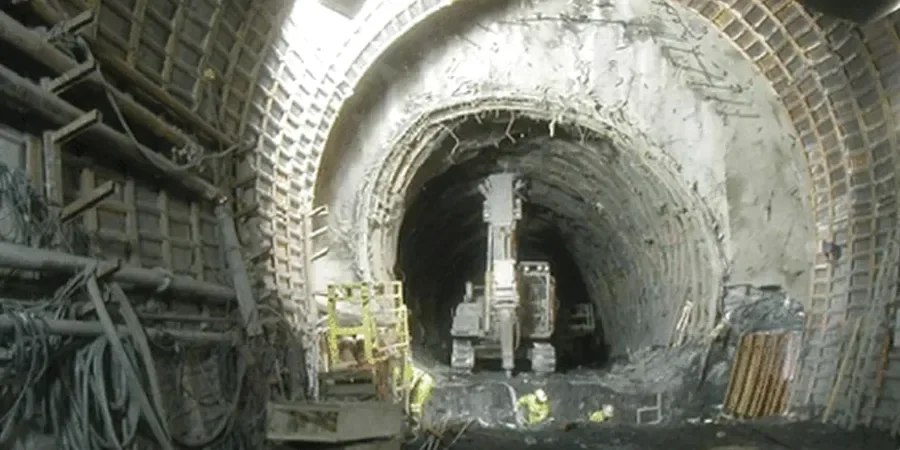
Regina sits at 577 m elevation in a glaciolacustrine basin where 30 to 40 m of soft, plastic Lake Regina clay overlies till, and the water table often sits barely 2 m below the surface. Tunneling here means dealing with squeezing ground, low undrained shear strength, and face instability if you get the parameters wrong. We run the full lab sequence, triaxial CU and UU, oedometer consolidation, and Atterberg limits, on undisturbed Shelby tube samples taken from the alignment, so the design team gets real numbers, not textbook assumptions. For tunnel alignments crossing the Wascana Creek floodplain or the downtown drift deposits, we often pair lab testing with field CPT testing to catch thin sand lenses that Shelby tubes miss, and with triaxial for effective stress strength envelopes under anisotropic consolidation.
Squeezing ground in Regina's clays can close a shield within hours if you underestimate the overconsolidation ratio. Lab consolidation curves tell the real story.
Local geotechnical context
Glaciolacustrine clay in the Regina basin is weakly overconsolidated, with OCR values around 1.5 to 2.5 near the surface dropping to 1.0 at depth. That means long-term creep settlement around the tunnel crown and potential for face extrusion during open-mode excavation. The biggest risk we see in the lab is sample disturbance: if the Shelby tube isn't handled right, Su drops 30% and you end up specifying an overkill support system or, worse, an under-designed one. We run consolidation tests to at least 800 kPa to capture the full e-log σ' curve and report preconsolidation pressure by Casagrande method. For seismic assessment under NBCC, we run cyclic triaxial on select specimens to evaluate modulus degradation and damping curves at strains relevant to the Regina seismic hazard level, which is moderate but not negligible given the 2011 M5.0 event near Yorkton.
Common questions
What lab tests are mandatory before tunneling in Regina's soft clay?
At minimum, consolidation (ASTM D2435) to get Cc, Cr, Cv, and preconsolidation pressure; UU triaxial (ASTM D2850) for undrained shear strength; Atterberg limits (ASTM D4318); and water content. If the tunnel is deeper than 8 m or uses an EPB machine, we add CU triaxial with pore pressure measurement and grain size distribution by hydrometer to evaluate conditioning requirements.
How much does a geotechnical lab program for a soft soil tunnel cost in Regina?
A complete lab program for a tunnel alignment, including Shelby tube extrusion, consolidation, triaxial, index testing, and a factual data report, typically ranges from CA$5,460 to CA$25,060 depending on the number of boreholes, sampling frequency, and whether advanced cyclic or abrasivity tests are included.
How do you prevent sample disturbance in Regina's sensitive clays?
We specify 76 mm thin-wall Shelby tubes with a 6° cutting edge and an area ratio under 10%. Samples are wax-sealed in the field, transported vertically in insulated containers, and extruded in the lab within 48 hours using a hydraulic extruder controlled at less than 1 mm/s. We log recovery ratio and visible disturbance before trimming the specimen.