We see it all the time here in Regina—contractors who price a project assuming shallow footings, only to hit that slick, high-plastic clay at three metres and watch the budget evaporate into over-excavation and fill replacement. The expansive nature of the Regina clay, part of the glacial Lake Regina plain, doesn't forgive assumptions. A proper pile foundation design is what keeps your structure from moving with every seasonal moisture cycle. Our lab team works directly with the glacial till that underlies most of the city at depth, verifying shaft resistance and end-bearing parameters through rigorous testing rather than textbook defaults. When a commercial project in the Ross Industrial Area needs to bypass the active zone, we correlate in-situ data from a CPT test to refine the pile capacity before a single rig mobilizes. It's the only way to avoid costly redesigns once steel is already on order.
In Regina's expansive clay, a pile foundation isn't just a structural element—it's the moisture barrier between your building and a moving landscape.
Process overview
A practical observation from years of drilling in Regina: the contact between the upper lacustrine clay and the dense till below is never as textbook-clean as the borehole logs from the 1970s suggest. We often encounter a transition zone of silty clay with scattered pebbles that can fool a standard SPT hammer into refusal, yet a driven pile will punch right through it if you have the right driving criteria. Our approach to pile foundation design leans heavily on local load test databases and laboratory strength testing of undisturbed Shelby tube samples. We run unconfined compression and consolidated-undrained triaxial tests on the clay to nail down the adhesion factor, because using a generic alpha value from a manual written for Ontario clay leads to either dangerously optimistic or absurdly conservative pile lengths. For the till, we focus on relative density and particle-size distribution, knowing that a well-graded matrix can sustain high end-bearing pressures if the pile tip is seated properly below any weathered crust. The design process also accounts for downdrag from consolidating fill, a scenario we encounter regularly on brownfield sites near the refinery corridor.
Local geotechnical context
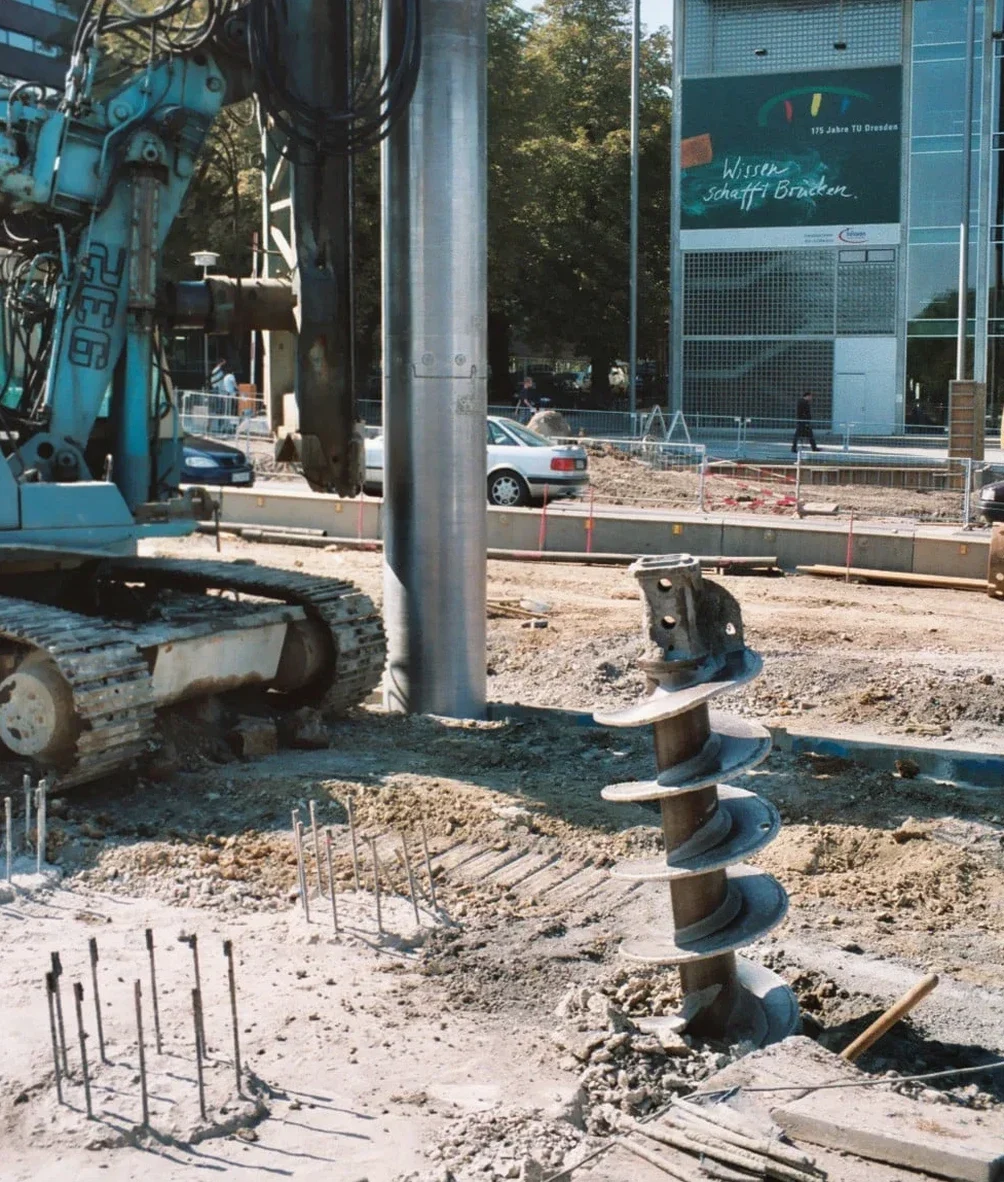
The rig we see most often on Regina sites is a crawler-mounted rotary or a hydraulic hammer driving H-piles through the crust. The sound a diesel hammer makes when it hits refusal on a glacial erratic boulder is unmistakable—a sharp, high-frequency ring instead of the dull thud of penetration. That's the moment when a purely prescriptive design falls apart. Without a solid pile foundation design that anticipates obstructions, you risk pile damage, refusal above grade, or a sudden need to splice or relocate piles. We've measured driving stresses near the steel yield point on sites east of the bypass where the till contains granite boulders transported from the Precambrian Shield. Our risk assessment includes wave equation analysis of driveability, so the contractor knows whether a given hammer can install the pile to the design depth without damage. Ignoring this in Regina means risking a pile that looks fine from the surface but has a microfractured tip section.
Common questions
What's the typical depth for pile foundations in Regina?
It depends entirely on the site, but we commonly see pile tips bearing in the dense glacial till between 10 and 18 metres below grade. Areas with thicker lacustrine clay deposits, especially in the older parts of the city, may require deeper piles. The key is getting past the active moisture zone and into the overconsolidated till.
How do you account for the expansive clay in the design?
We use lab-derived swelling pressure and soil suction profiles to estimate the uplift and downdrag forces on the pile shaft. The pile is then designed to either resist these forces structurally or to isolate the structure from the moving soil through a void form or sleeved section in the active zone.
What pile type do you usually recommend for Regina conditions?
For most mid-rise commercial and industrial buildings, driven steel H-piles or closed-end pipe piles work well because they can penetrate the stiff clay and seat into the till reliably. Drilled shafts (caissons) are an option but require careful attention to sidewall stability in the clay and potential softening at the base.
Can you design piles that resist frost heave as well?
Yes. Frost penetration depth in Regina is specified in the NBCC, and we detail the upper portion of the pile to either resist adfreeze forces or include a bond breaker. The design must satisfy both the deep foundation requirements and the seasonal frost protection criteria simultaneously.
What's the typical cost range for a pile foundation design package for a commercial building in Regina?
For a standard commercial building with a moderate number of boreholes, the pile foundation design phase typically ranges from CA$2,400 to CA$8,720, depending on the complexity of the soil profile, the number of load cases, and whether a load test program is included.