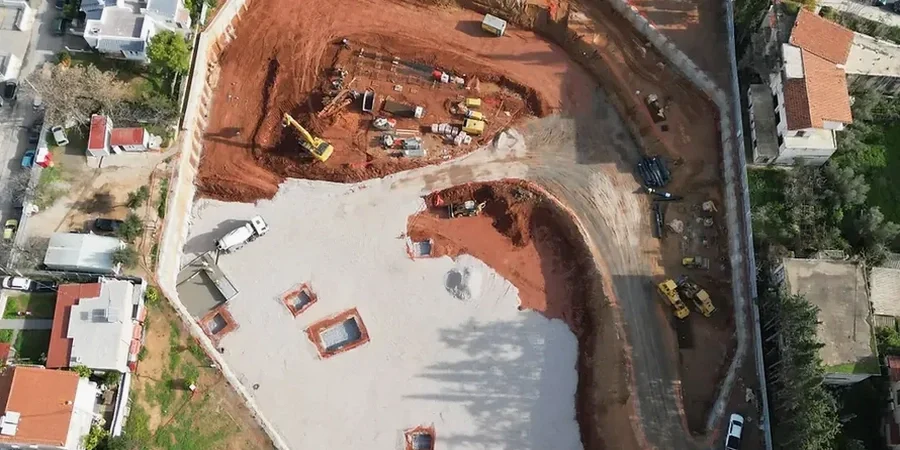
The skyline of downtown Regina is punctuated by tower cranes as often as grain elevators these days, and with each new multi-storey development comes the challenge of going deep. The city sits squarely on the lacustrine clays of glacial Lake Regina, a deposit that ranges from highly plastic fat clays to silty tills, and at depths exceeding 5 meters, the behaviour of these materials can change dramatically. A recent build on Victoria Avenue required a 12-meter excavation for a three-level parkade, where the design had to account not just for lateral earth pressures but for the long-term swelling potential of the Bearpaw Formation. This is where a rigorous geotechnical investigation becomes the non-negotiable first step, because the difference between a successful shoring system and a costly setback often lies in a single overlooked silt seam. Our team approaches these projects by building a detailed ground model that integrates stratigraphy with the specific unloading-reloading cycles these sensitive clays track record during bulk excavation.
In Regina's overconsolidated clays, wall deflections are governed by time-dependent unloading, not just peak excavation depth.
Process overview
In Regina, one thing we consistently observe is that the interface between the glacial till and the underlying Bearpaw Shale acts as a natural conduit for groundwater, a condition that can turn a standard excavation into a dewatering-intensive operation. The design of any deep support system here must therefore couple structural analysis with a solid hydrogeological assessment. Wall deflections in these overconsolidated clays tend to be time-dependent, so we place heavy emphasis on the undrained shear strength parameters derived from field vane tests and triaxial compression. Rather than applying generic pressure diagrams, our calculations incorporate the actual pre-consolidation pressure of the deposit, which often exceeds 300 kPa. When the excavation footprint is tight, integrating
tie-back anchors into the design allows for an open cut without internal bracing, but this demands a precise understanding of the bonded zone within the competent till. For sites near Wascana Creek, where alluvial silts introduce a liquefiable layer, we often recommend coupling the shoring design with a
seismic microzonation study to verify that the wall will perform under the 1-in-2,475-year earthquake specified by the NBCC for Regina.
Local geotechnical context
The Regina area is underlain by the Bearpaw Formation, a Cretaceous shale that is notorious for its swelling properties when unloaded and exposed to moisture. A deep excavation triggers a rapid stress relief that can cause heave of the subgrade exceeding 100 mm, particularly if the excavation is left open through a wet spring. The risk is not merely geotechnical but structural: differential heave can crack raft slabs and shear pile caps before the superstructure is even framed. Base instability is another concern, as a high artesian pressure in the basal aquifer has been recorded in several boreholes north of Dewdney Avenue; without proper relief wells or a thick enough plug of till, a blowout at the base of the excavation is a real possibility. Even with a well-designed monitoring program that tracks inclinometers and piezometers daily, the rapid deterioration of these clays upon contact with air demands that the final trim be protected within hours, a logistical constraint that directly influences the geotechnical design sequence.
Common questions
Why does a deep excavation in Regina require a staged construction approach?
The lacustrine clays of glacial Lake Regina exhibit significant time-dependent behaviour. If you unload these soils too quickly in a single cut, the resulting negative excess pore pressures can cause a delayed basal heave. A staged approach, where the excavation is advanced in lifts and the shoring is installed sequentially, allows partial dissipation of these pressures and keeps wall deflections within the tolerances required by CSA A23.3 for adjacent foundations.
What is the typical cost range for a deep excavation design in Regina?
Professional fees for geotechnical design of deep excavations in Regina typically range from CA$2,480 for a straightforward single-level basement to CA$11,600 for a complex multi-level excavation requiring 3D finite element analysis and a full instrumentation plan. The final figure depends on the depth of the cut, the proximity of neighbouring structures, and the complexity of the groundwater control system required.
How does the Bearpaw Formation affect excavation design?
The Bearpaw Formation is a Cretaceous-age shale that acts as an aquitard but is highly susceptible to swelling when its moisture content changes. In an excavation, exposing the Bearpaw can lead to rapid slaking of the surface and a reduction in passive resistance. Our designs always specify a protective shotcrete or lean concrete blinding layer applied immediately after trimming to preserve the strength of the contact zone.
Which loading conditions govern the design of shoring walls in Saskatchewan?
For Regina, the governing load cases are derived from the NBCC 2020 seismic provisions, which place the city in a moderate seismicity zone with a 2% probability of exceedance in 50 years. However, for deep cuts in stiff clay, the long-term drained condition — where the full hydrostatic pressure acts on the wall and the clay relaxes — often produces greater bending moments than the short-term seismic event. Our reports explicitly check both the undrained seismic case and the fully softened drained case.